
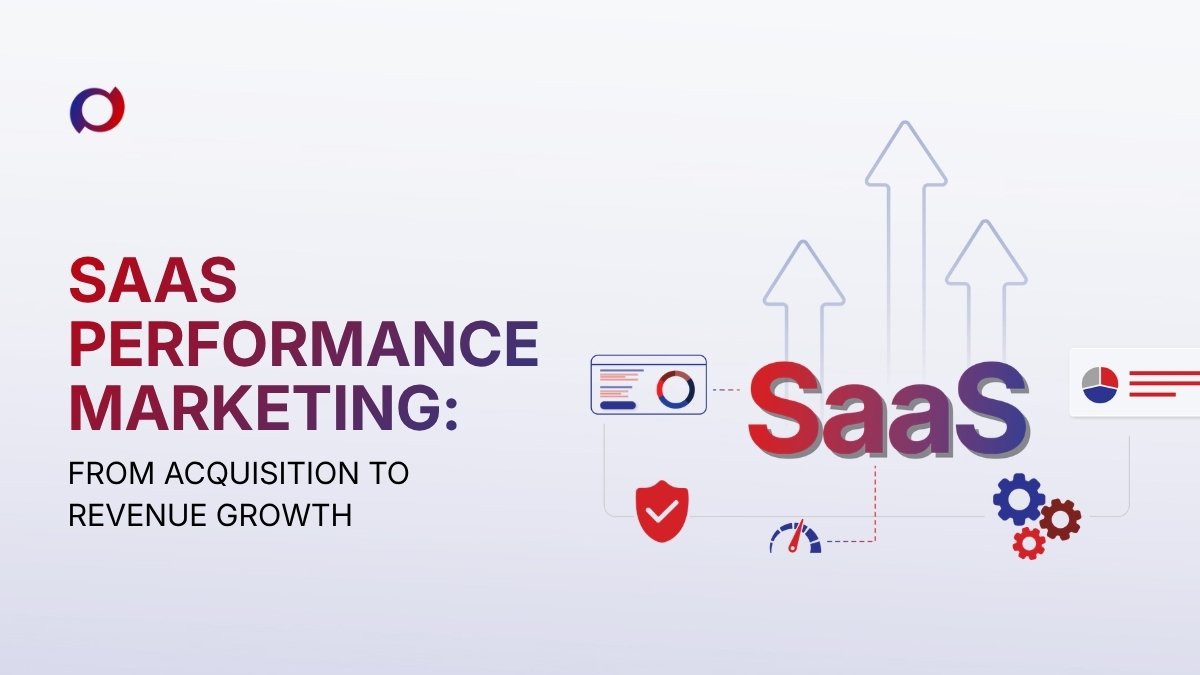
SaaS Performance Marketing: From Acquisition to Revenue Growth
Posted in October 16, 2026
Share On




Here is a scenario that plays out more often than most SaaS marketing teams want to admit. Budgets get doubled for the quarter. The campaigns run sharper across Google and LinkedIn. Sign-ups climb by 40 percent. The sales team celebrates the inbound volume. And then the quarterly business review arrives and the CFO asks a very simple question: where is the MRR?The sign-ups were real. The campaigns hit every target they were set. But when you follow the customer journey past the initial conversion — through trial, activation, first payment, and renewal — the picture changes. Most of those sign-ups never activated the product meaningfully. A significant portion churned before the end of their first month. The customers who stayed and paid were almost exclusively coming from one specific audience segment that had been generating a fraction of the total volume.More spend had produced more activity without producing more revenue. That is the exact problem that SaaS performance marketing exists to solve — and it starts by redefining what “performance” actually means in a subscription business.
Impressions, click-through rates, and cost per lead all have a place in channel-level reporting. They should not be mistaken for measures of programme effectiveness. The metrics above connect marketing investment to business outcomes — which is a different thing entirely.
Table of Contents
ToggleWhat Is SaaS Performance Marketing?
Performance marketing, in general terms, means running campaigns where success is measured against specific, measurable outcomes — conversions, leads, sales — rather than brand metrics like impressions or reach.For SaaS businesses, that definition needs to extend considerably further. A sign-up is not a conversion in any commercially meaningful sense if that person never becomes a paying subscriber. A demo booking is not a pipeline contribution if the person who attended was never a realistic buyer. Cost per lead is a useful budget-planning number, but it tells you almost nothing about whether your marketing is growing the business.SaaS performance marketing means aligning every campaign investment — across every channel — with outcomes that actually move the business: qualified pipeline, activated trials, paid conversions, and retained subscribers. It is performance marketing applied to the full subscription lifecycle, not just the top of the funnel.Why SaaS Businesses Need a Performance-Led Growth Strategy
The economics of SaaS make performance marketing more important, and more complex, than in most other business models.- Longer sales cycles and multiple decision-makers: enterprise and mid-market SaaS deals often involve three to eight stakeholders and take months to close. A performance strategy that optimises for speed of conversion will consistently undervalue high-quality prospects who simply are not ready to make a decision this week. The metrics you use to measure campaigns need to account for that lag.
- Free trials and freemium conversion challenges: free access is a powerful acquisition mechanism and a notoriously difficult conversion problem. Getting someone into a trial costs marketing budget. Converting them into a paying subscriber requires a completely separate set of interventions — activation campaigns, onboarding experiences, and timed follow-up that responds to usage behaviour. Performance marketing that stops at the sign-up has solved only the easy part of the equation.
- Recurring revenue and customer retention: in a subscription model, the economics of customer acquisition only make sense when you factor in how long a customer stays and what they pay over that time. A CAC of ₹30,000 for a customer who churns after two months is far worse than a CAC of ₹50,000 for a customer who stays for three years. Performance marketing frameworks that do not incorporate LTV/CAC ratios and payback periods are optimising against the wrong target.
The Core Channels in a SaaS Performance Marketing Strategy
Google Search Ads for High-Intent Demand
When a prospect types a query like “best project management software for engineering teams” into a search engine, they have already identified a problem and started evaluating solutions. Google Search campaigns capture this intent at its peak and place your product in front of buyers who are already in evaluation mode.For SaaS, the most valuable search queries are often comparison terms (“X vs Y”), use-case searches (“software for [specific workflow]”), and branded competitor terms. These tend to carry higher purchase intent and consequently higher conversion potential — even when they generate lower search volume than broader category queries. Structuring campaigns around intent tiers, rather than keyword volume alone, is what separates effective SaaS search campaigns from expensive ones.LinkedIn and B2B Paid Acquisition
LinkedIn’s value for B2B SaaS is not that it delivers the cheapest leads — it often does not. Its value is that it delivers the most precisely targeted leads. You can reach the specific job title, seniority level, company size, and industry that defines your ICP, regardless of whether those people are currently searching for a solution.Effective LinkedIn campaigns for SaaS are typically structured in layers: awareness content to build familiarity with the brand and problem framing, consideration campaigns to communicate product value, and conversion campaigns — often using LinkedIn’s native Lead Gen Forms — to capture intent from warmed audiences. Running LinkedIn as a direct-response channel without the earlier layers usually delivers disappointing economics.Meta Ads for Retargeting and Remarketing
Meta platforms are less commonly a primary acquisition channel for B2B SaaS, but they are effective for retargeting. Visitors who explored your pricing page but did not convert, trial users who signed up but never activated, and prospects who attended a webinar and then went quiet — all of these audiences can be re-engaged through Meta campaigns at considerably lower CPCs than LinkedIn’s cold acquisition costs.Retargeting on Meta works because the audience already has some level of familiarity. The creative can acknowledge where they are in the consideration process rather than starting from scratch, and that specificity tends to improve both click rates and conversion quality.SEO and Content for Sustainable Acquisition
Paid channels generate results as long as budget is running. SEO builds an asset that compounds over time. For SaaS businesses, a content strategy aligned with search intent across the full funnel — from early awareness queries to bottom-funnel comparison terms — creates a source of qualified traffic that does not disappear when the ad budget is paused.The important distinction is timing. SEO takes months to generate meaningful results. Businesses that invest in content early build a sustainable acquisition advantage that paid channels alone cannot replicate — one that also tends to improve the quality of traffic entering the funnel, because organic content attracts readers who are genuinely engaged with the topic.Email and Lifecycle Marketing for Activation
Email tends to be categorised as a retention tool, but in SaaS it plays a critical performance role at the point of activation. The difference between a trial user who activates and one who does not is almost always a combination of product experience and communication. Timed onboarding sequences, feature prompt emails, and usage milestone messages are performance marketing tools applied inside the product lifecycle — and they directly affect the trial-to-paid conversion rates that the acquisition campaigns are ultimately judged against.How to Build a SaaS Performance Marketing Funnel
A SaaS funnel does not end at the point of sign-up. It ends at the point of sustained, renewed, and ideally expanded subscription. Understanding what happens at each stage between those two points makes it possible to identify exactly where the business is losing potential revenue.- Awareness: target audiences who fit the ICP but are not yet familiar with your solution. This stage is about being present in the right places when your ideal customer begins to recognise the problem you solve — before they start actively searching, before they ask their peers, before a competitor earns their consideration first.
- Lead capture: demo requests, free trial sign-ups, content downloads, and webinar registrations are the conversion events that move a prospect from anonymous to known. The quality of your capture mechanism — how much friction exists, how clearly value is communicated, how relevant the ask is to where the prospect is in their thinking — directly affects what enters your pipeline downstream.
- Demo or trial: for demo-led businesses, the demonstration is where the product earns the deal or loses it. For product-led businesses, the trial activation experience performs the same function. Both require active optimisation beyond simply delivering access and hoping for the best.
- Activation: the moment a user first experiences the core value of your product — sometimes called the “aha moment” — is the pivot point between a conversion that holds and one that churns. Identifying this moment and engineering the path to it as efficiently as possible is one of the highest-value interventions in SaaS marketing, and one that is frequently left entirely to the product team.
- Paid conversion: the transition from free to paid is influenced by product experience quality, conversion messaging effectiveness, and often the timing of sales outreach. For product-led growth companies, pricing page conversions are a direct performance marketing outcome — and pricing page optimisation deserves the same systematic testing that landing pages receive.
- Retention: keeping customers past their first renewal is not just a success team responsibility. Marketing campaigns that remind customers of delivered value, surface relevant new features, and build relationship ahead of renewal conversations have a measurable impact on net revenue retention — and net revenue retention is the metric that most directly determines whether a SaaS business is building enterprise value.
SaaS Performance Marketing Metrics to Track
| Metric | What it measures | Why it matters |
|---|---|---|
| Customer Acquisition Cost (CAC) | Total sales + marketing spend ÷ new customers | The foundational unit economics of growth |
| Cost per qualified lead | Spend ÷ leads meeting MQL threshold | Filters out noise from raw cost per lead figures |
| Demo-to-customer conversion rate | % of demos that become paying subscribers | Reveals the commercial quality of the pipeline |
| Trial-to-paid conversion rate | % of trial users who convert to a paid plan | Direct measure of product-led growth efficiency |
| Customer Lifetime Value (LTV) | Average revenue × average retention period | The numerator in the LTV/CAC ratio |
| LTV/CAC ratio | LTV ÷ CAC | A ratio above 3:1 is typically considered healthy for SaaS |
| Payback period | Months to recover CAC from gross margin | Shows how long the business carries acquisition costs |
| Marketing-attributed revenue | Revenue traceable to specific campaigns | Connects spend to commercial outcomes |
How to Improve SaaS Marketing ROI
- Test landing pages more often than feels necessary: a two-percentage-point conversion rate improvement on a high-traffic landing page compounds significantly across a campaign’s lifetime. Most SaaS businesses test far less frequently than the data volume they generate would allow.
- Refine audience qualification upstream: the cheapest way to improve lead-to-customer conversion rates is to exclude audiences unlikely to convert before they enter the funnel. Negative keyword targeting, audience exclusions, and ICP-tightening exercises reduce wasted spend without changing campaign bids.
- Move to revenue-based attribution: last-click attribution — still the default in many advertising platforms — systematically misattributes credit to the final touchpoint in a customer journey and defunds earlier-stage channels. Moving to a first-touch, linear, or data-driven attribution model typically changes how budget is allocated across channels, and usually in ways that benefit longer-cycle, awareness-phase activity.
- Align campaign optimisation goals with the actual conversion event: if your Google campaigns are optimised for form fills but you care about demo completions, you are teaching the algorithm to deliver the wrong outcome. That misalignment is easy to create and slow to diagnose.
Common SaaS Performance Marketing Mistakes
- Optimising for cheap leads: low cost per lead almost always correlates with low intent. The brands most successful at SaaS lead generation have learned to stop celebrating cost-per-lead reductions, because that number typically moves inversely with lead quality. Cheaper and worse is not an improvement.
- Ignoring what happens after the sign-up: if performance marketing measurement ends at trial registration, you are evaluating campaigns without visibility into the most important part of the customer journey. This creates systematic incentives to optimise for the wrong thing.
- Relying on last-click attribution: in a multi-touch B2B buying journey, the last click is rarely the most important touchpoint. It is simply the most recent. Attribution models that give all the credit to the final action consistently defund the awareness and consideration campaigns that initiated the journey — and then those campaigns get cut, and pipeline dries up three months later.
- Treating all trial users identically: activation behaviour within a trial period is one of the strongest predictors of eventual conversion. Users who complete key actions in their first 48 hours convert at dramatically different rates than users who signed up and never returned. Segmenting trial users by behaviour and responding with different communication accordingly is a significant unlock that most SaaS businesses leave on the table.
How to Build a Scalable SaaS Growth Framework
A scalable performance marketing framework is not about running more campaigns. It is about building a system that learns what is working, concentrates budget on what is performing, and continuously improves the efficiency of each stage in the funnel.- Set goals aligned to revenue, not activity: every campaign should have a clear line of sight from its primary KPI to a commercial outcome — pipeline value, customer acquisition, or net revenue. If you cannot draw that line, the metric is measuring activity, not performance.
- Test channels before scaling them: budget allocation should follow evidence, not assumption. Testing a new channel at a controlled spend level before committing significant resources to it is how you avoid discovering that it underperforms at scale after the damage is done.
- Build a feedback loop with sales: the most effective SaaS performance marketing teams have a recurring conversation with their sales counterparts about lead quality, common objections, and which types of prospects are easiest and hardest to convert. That information should feed directly back into campaign targeting and audience strategy — not sit in a post-call debrief that marketing never sees.
- Measure the full funnel, always: dashboards that stop at lead count or trial registration actively harm decision-making because they give teams the impression that the marketing work is complete when a prospect submits a form. A full-funnel view — from impression to paid subscriber to renewal — is the only measurement framework that tells you whether the programme is actually working.
Frequently Asked Questions
What is SaaS performance marketing?
SaaS performance marketing is the practice of connecting paid acquisition, content, and lifecycle marketing directly to measurable business outcomes — qualified pipeline, trial conversions, paid subscriptions, and retained revenue. It extends the concept of performance marketing beyond form fills and sign-ups to the full subscription lifecycle.
Which channels work best for SaaS companies?
The most effective channel combination depends on your business model, target audience, and sales motion. B2B SaaS companies typically see the strongest results from Google Search for high-intent demand capture, LinkedIn for ICP targeting among decision-makers, and content and SEO for sustainable compounding acquisition. Meta retargeting adds a lower-cost layer to re-engage warm audiences.
How do SaaS companies calculate CAC?
Customer acquisition cost is calculated by dividing total sales and marketing spend in a given period by the number of new customers acquired in that same period. Some businesses calculate blended CAC (all spend ÷ all new customers) and paid CAC (paid marketing spend ÷ customers attributable to paid channels) separately, to understand the relative efficiency of organic versus paid acquisition.
How can SaaS businesses improve trial-to-paid conversion?
Trial-to-paid conversion typically improves through better onboarding design, clearer communication of product value during the trial period, timed in-app and email prompts tied to usage signals, and sales outreach coordinated around activation milestones. Identifying the activation event — the specific action that correlates most strongly with conversion — is the most valuable first step and often the most underinvested one.
Which metrics should SaaS marketers track?
The metrics that matter are CAC, cost per qualified lead, demo-to-customer conversion rate, trial-to-paid conversion rate, LTV/CAC ratio, payback period, and marketing-attributed revenue. These connect marketing activity to commercial outcomes. Impressions, click-through rates, and raw lead counts belong in channel-level reporting but should not be presented as measures of programme effectiveness.
Leave a Reply