
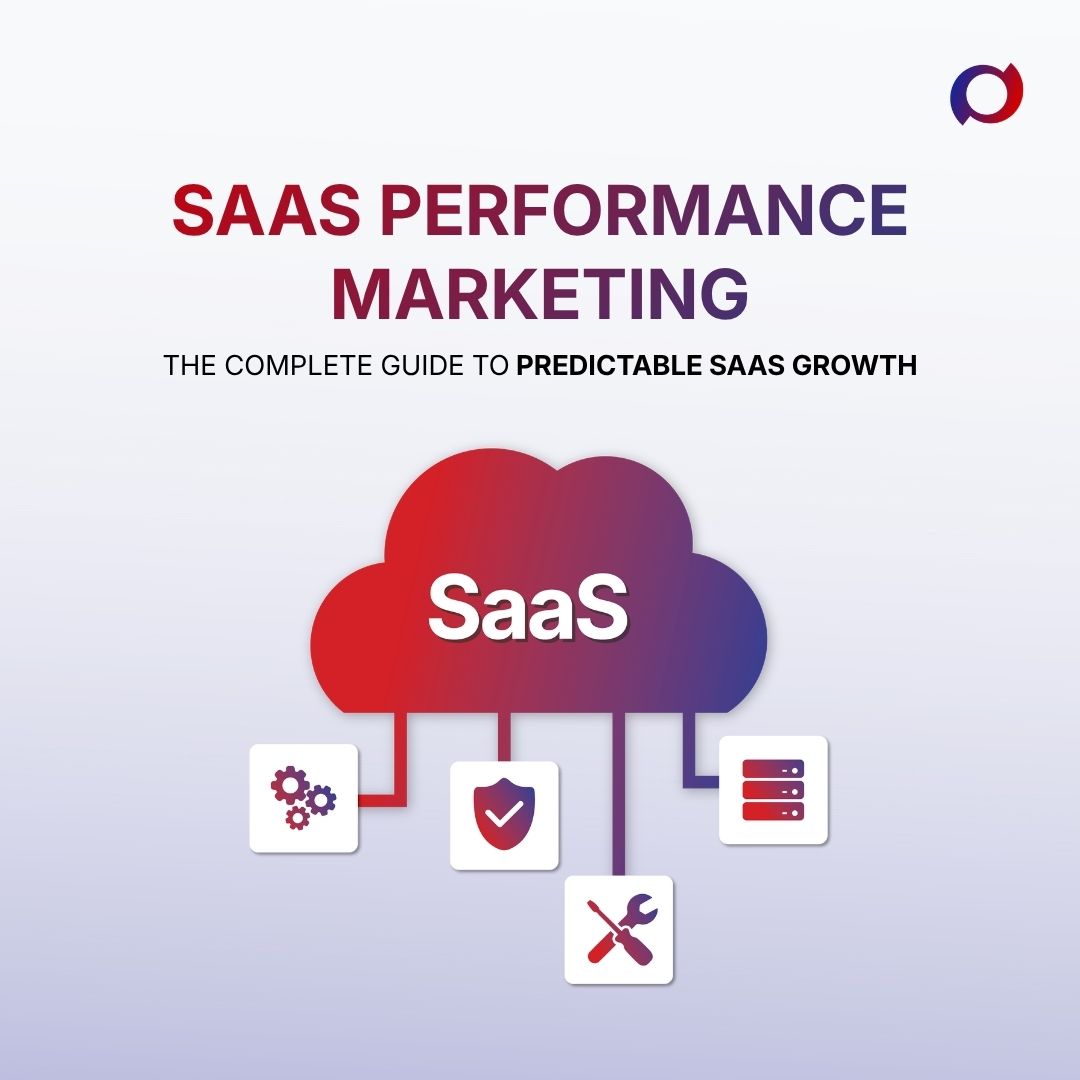
SaaS Performance Marketing: The Complete Guide to Predictable SaaS Growth
Posted in July 21, 2026
Share On




Table of Contents
ToggleIntroduction
Most SaaS founders can tell you their MRR to the rupee. Far fewer can tell you exactly which campaign, keyword, or channel produced it. That gap between revenue and its source is where growth stalls.SaaS performance marketing closes that gap. It is a measurement-first approach to acquisition where every rupee of spend is tied to a trackable outcome: a trial signup, a demo, a paid conversion. At AD360, we have applied this model across 500+ ad accounts in India, the US, UK, Canada, Australia and Dubai, and the pattern is consistent. SaaS companies that measure ruthlessly grow predictably. Those that do not, guess.Traditional marketing built awareness and hoped conversions followed. That worked when acquisition was cheap. It is not cheap anymore.B2B SaaS customer acquisition costs have climbed 40 to 60 percent since 2023, and the median SaaS company now spends $2.00 to acquire every $1 of new ARR. At those economics, spray-and-pray is not a strategy. It is a leak.In this guide, you will learn what SaaS performance marketing actually involves, how the SaaS funnel works stage by stage, which channels earn their budget, the metrics that matter, the mistakes that quietly inflate CAC, and how AI and answer-engine optimization are rewriting the playbook in 2026.What is SaaS Performance Marketing?
SaaS performance marketing is a data-driven acquisition model where campaigns are planned, bought, and optimized against measurable business outcomes such as trials, demos, MQLs, and recurring revenue, rather than impressions or reach.The word “performance” is the contract. You pay for results you can count, and you cut what you cannot attribute.How it differs from traditional marketing
| Traditional Marketing | Performance Marketing |
|---|---|
| Optimizes for reach and recall | Optimizes for conversions and revenue |
| Success measured in impressions | Success measured in CAC, ROAS and LTV |
| Attribution is loose or absent | Attribution is built in before launch |
| Budget fixed in advance | Budget follows what is working |
| Results reviewed quarterly | Results reviewed weekly, often daily |
What SaaS performance marketing includes
- Customer acquisition: paid and organic programs designed to add paying subscribers, not just traffic.
- Lead generation: capturing demo requests, trial signups and MQLs through targeted campaigns and offers.
- Paid media: Google Ads, LinkedIn, Meta and programmatic buys managed against strict cost-per-outcome targets.
- Conversion optimization: landing page, pricing page and onboarding improvements that lift signup and trial-to-paid rates.
- Revenue attribution: connecting ad platforms, GA4 and CRM data so every closed deal traces back to its source.
Why Performance Marketing Matters for SaaS Companies
Predictable revenue growth. When you know that ₹X of spend reliably produces Y trials and Z paid customers, growth stops being a hope and becomes a budget line. You can scale acquisition and forecast marketing ROI with confidence.Lower customer acquisition cost. B2B SaaS CAC typically runs $200 to $700 and beyond, with median self-serve CAC at $702 and sales-led at $11,400. Performance discipline attacks that number directly by killing wasted spend, keyword by keyword.Better marketing attribution. Full-funnel tracking from click to closed-won means budget decisions are based on revenue data, not opinions in a review meeting.Faster experimentation. Weekly optimization cycles let you test creatives, audiences and offers in days. Losers die fast; winners get budget.Improved lead quality. Intent-based targeting and qualification filters mean sales talks to buyers, not browsers. That shows up in SQL rates and close rates.A scalable growth engine. Once unit economics work at ₹1 lakh a month, the same system usually works at ₹10 lakh. Performance marketing is the only acquisition model built to scale on evidence rather than optimism.The SaaS Performance Marketing Funnel
SaaS buyers rarely convert on first touch. B2B sales cycles now average around 134 days, up from 107 days in early 2022, so your funnel needs distinct jobs at each stage. Here is how we structure it at AD360.Top of Funnel (TOFU): Get discovered
Objectives: brand awareness and qualified traffic.Channels: Google Search, LinkedIn Ads, Meta Ads, SEO, content marketing, and YouTube.KPIs: impressions, CTR, CPC.TOFU is where most SaaS budgets get wasted. The fix is intent: target problem and solution keywords, not category vanity terms.Middle of Funnel (MOFU): Earn trust
Objectives: lead generation and product education.Strategies: case studies, webinars, free tools, comparison pages, and email nurturing.KPIs: MQLs, demo requests, free trial signups.MOFU is where conversion rates diverge sharply. Across B2B SaaS, MQL-to-SQL conversion averages 32 to 40 percent, and the gap between top and median performers is mostly nurture quality, not lead volume.Bottom of Funnel (BOFU): Convert
Objectives: turn evaluators into paying customers.Strategies: demo booking flows, sales enablement, testimonials, ROI calculators, and pricing pages that answer objections instead of hiding prices.KPIs: CAC, SQLs, paid conversions, revenue.Trial design matters enormously here. Opt-in trials with no card convert at roughly 18.2 percent, versus 48.8 percent when a card is required. Neither is “right”; the choice depends on your traffic volume and sales motion.Best SaaS Performance Marketing Channels
Google Ads
Search captures buyers at the moment of intent. Target high-intent keywords (“project management software for agencies”), competitor keywords, and solution keywords. Best campaign types for SaaS: Search, Performance Max, Demand Gen, and remarketing. Our Google Ads team has taken accounts from underperformance to 12X conversion growth with a 90 percent drop in cost per conversion using exactly this structure. For a deeper walkthrough, read our guide to Google Ads for lead generation.LinkedIn Ads
LinkedIn is the default paid channel for B2B SaaS, and the data supports it: 80 percent of all B2B social media leads come from LinkedIn, with a visitor-to-lead conversion rate of 2.74 percent. Lead Gen Forms convert at around 13 percent. Use Lead Gen Forms, Sponsored Content, Conversation Ads, and ABM campaigns for named-account targeting.SEO
Paid ads stop when spend stops; SEO compounds. Focus on topical authority, programmatic SEO for scale, BOFU landing pages, comparison pages (“X vs Y”, “X alternatives”), and product-led SEO where the product itself answers the query. SEO also delivers the lowest cost per lead of any B2B channel at around $31. We used this compounding approach to grow Coco Sutra’s organic traffic 579 percent.Content Marketing
Companies that blog consistently generate 13x more leads than those that do not. For SaaS, prioritize industry reports, product comparisons, templates, guides, and use cases: content a buyer can act on, not content that fills a calendar.Email Marketing
Email remains the highest-ROI channel in digital marketing at roughly $36 returned for every $1 spent. For SaaS, automation does the heavy lifting: trial nurturing sequences, feature education, upsell flows, and win-back campaigns for churned accounts.Retargeting
Most visitors leave without converting, and retargeting is how you get them back. Retargeted visitors are 70 percent more likely to convert. Run it across Google Display, LinkedIn, and Meta, with separate audiences for trial users, demo page visitors, pricing page visitors, and blog readers. Pricing page visitors are your warmest audience; treat them that way. Programmatic extends this reach across OTT, native, and display inventory.SaaS Performance Marketing Metrics That Actually Matter
Track fewer metrics, but track them honestly. These twelve tell you whether the engine works.| Metric | Why It Matters |
|---|---|
| CAC | Measures customer acquisition efficiency |
| LTV | Long-term profitability per customer |
| LTV:CAC Ratio | Overall business health; aim for 3:1 or better |
| MRR | Monthly recurring revenue and growth trajectory |
| ARR | Annual recurring revenue for planning and valuation |
| ROAS | Advertising effectiveness per channel |
| Conversion Rate | Funnel performance at each stage |
| Churn Rate | Customer retention; growth leaks start here |
| Payback Period | How fast you recover CAC |
| Trial-to-Paid Conversion | Whether the product delivers value fast |
| SQL Rate | Lead quality reaching sales |
| Pipeline Revenue | Marketing’s real impact on sales outcomes |
Building a High-Converting SaaS Marketing Strategy
Step 1: Define your ICP
Nail down industry, company size, pain points, and the actual decision makers. “B2B companies” is not an ICP; “marketing heads at 50-200 person Indian D2C brands struggling with attribution” is.Step 2: Keyword research
Map keywords to intent: solution keywords, problem keywords, comparison keywords, “[competitor] alternatives”, and “best [category] software”. Comparison and alternatives keywords are the highest-converting terms in SaaS and usually the cheapest ROAS wins.Step 3: Landing page optimization
Every campaign deserves a dedicated page with social proof, testimonials, product screenshots, video, FAQs, and one clear CTA. If your site itself is the bottleneck, fix that first; our website development team builds SaaS pages architected for speed and conversion.Step 4: Launch paid campaigns
Start with Google Search for intent capture, LinkedIn for ICP precision, and retargeting from day one. Unsure how to split budget between platforms? Our comparison of Google Ads vs Meta Ads breaks down when each wins.Step 5: Optimize weekly
Review CTR, CPC, conversion rate, and CAC every week. Reallocate budget toward what converts, pause what does not, and feed learnings back into targeting and creative. Optimization cadence, not budget size, is what separates compounding accounts from stagnant ones.Common SaaS Performance Marketing Mistakes
- Targeting everyone: broad audiences burn budget on people who will never buy.
- Ignoring intent-based keywords: chasing volume over intent fills the funnel with browsers.
- Poor landing pages: sending paid traffic to a generic homepage wastes every click.
- Weak messaging: feature lists do not convert; outcomes and proof do.
- No attribution setup: launching before conversion tracking works means optimizing blind.
- Not measuring CAC: if you cannot state your fully loaded CAC, you cannot manage it.
- Optimizing only for traffic: traffic is a cost until it converts.
- No retargeting: you paid to earn the visit; leaving without a retargeting layer throws it away.
- Ignoring organic SEO: all-paid acquisition means your CAC rises every time CPCs do, and Google CPCs rose 164 percent between 2019 and 2024.
Performance Marketing vs Growth Marketing for SaaS
These are complements, not competitors. Performance marketing is the acquisition engine; growth marketing is the whole vehicle.| Performance Marketing | Growth Marketing |
|---|---|
| Focused on paid acquisition | Covers the entire customer journey |
| ROI-focused, campaign by campaign | Sustainable growth across the lifecycle |
| Short-term, measurable wins | Long-term retention and expansion |
| Campaign optimization | Product plus marketing optimization |
| Paid channels | All acquisition channels |
AI’s Role in Modern SaaS Performance Marketing
AI has moved from buzzword to line item. Companies using AI in acquisition report up to 50 percent lower customer acquisition costs. The practical applications right now:- AI-powered bidding: Smart Bidding and value-based bidding outperform manual bids at scale.
- Predictive audiences: platforms model who is likely to convert before they signal it.
- Automated reporting: dashboards that surface anomalies instead of waiting for month-end reviews.
- Creative optimization and AI-generated ad copy: rapid variant testing at a scale humans cannot match.
- Landing page personalization: dynamic content matched to industry, source, or intent.
- Marketing automation: behavior-triggered nurture that adapts to what each trial user actually does.
LLM and AI search optimization (GEO)
This is the biggest shift in SaaS discoverability since mobile. Google’s AI Overviews now appear on roughly 25 percent of searches and reach about 2 billion users monthly. When an AI Overview appears, CTR for the top organic result drops by around 58 percent, and zero-click searches have climbed from 56 to 69 percent in a single year.The response is Generative Engine Optimization: structuring content so ChatGPT, Gemini, Perplexity and AI Overviews cite your brand in their answers. Build topical authority and entity-based content, answer specific questions directly, and keep pages crawlable. Ranking still matters: 94 percent of AI Overviews cite at least one top-20 URL, so strong traditional SEO remains the entry ticket to AI visibility.What Performance Marketing Results Look Like in Practice
Challenge: an ATV accessories brand was running Google Ads with unclear returns and rising costs.Strategy and channels: AD360 restructured the account around high-intent search and shopping campaigns with strict conversion tracking and controlled cost management.Results: the account delivered 468 purchases, $186,533 in purchase value, and a 7X ROAS. In a parallel Meta engagement, 9M Clinic saw conversions grow 2.1x while cost per valid lead fell 27.7 percent. Different industries, same system: track everything, cut waste, scale winners. Browse more AD360 case studies for the full breakdowns.SaaS Performance Marketing Checklist
- Define your ICP
- Set measurable KPIs
- Conduct intent-mapped keyword research
- Build optimized landing pages
- Launch Google Ads
- Launch LinkedIn campaigns
- Create comparison pages
- Implement retargeting across Google, LinkedIn and Meta
- Track conversions end to end
- Measure CAC and LTV monthly
- Optimize weekly
- Improve SEO continuously
- Build AI-search-friendly content for GEO
Conclusion
Performance marketing enables predictable, scalable SaaS growth because it replaces assumptions with attribution. Every stage of the funnel gets a number, every number gets an owner, and budget flows to what provably works.Success depends on alignment: paid media, SEO, content, conversion optimization and lifecycle marketing all pointed at the same measurable business outcomes, not operating as separate silos.And the bar keeps rising. Continuous testing, honest attribution, and AI-powered optimization are what keep CAC falling while competitors watch theirs climb. If you want a team that has done this across 500+ ad accounts, talk to AD360’s performance marketing team or get started here.Frequently Asked Questions
What is SaaS performance marketing?
It is a measurable, data-driven approach to SaaS customer acquisition where campaigns are
optimized against outcomes such as trials, demos, CAC and revenue rather than impressions or reach.
How is SaaS marketing different from traditional marketing?
SaaS marketing must account for recurring revenue, trials, churn and payback periods.
Traditional marketing measures awareness; SaaS performance marketing measures acquisition cost against customer
lifetime value.
Which channels work best for SaaS companies?
Google Search for intent capture, LinkedIn for B2B precision, SEO and content for compounding
organic growth, plus email nurturing and retargeting to convert warm audiences.
How do you reduce CAC in SaaS?
Tighten ICP targeting, shift budget to intent keywords, improve landing page conversion, invest
in organic channels, and add retargeting. Retargeted visitors are 70 percent more
likely to convert, which directly lowers blended CAC.
What KPIs should SaaS marketers track?
CAC, LTV, LTV:CAC ratio, MRR, ARR, ROAS, conversion rates, churn, payback period, trial-to-paid
conversion, SQL rate, and pipeline revenue.
Is SEO better than PPC for SaaS?
They serve different jobs. PPC delivers immediate, controllable volume; SEO compounds and
carries the lowest cost per lead of B2B channels at around $31. Mature SaaS programs run
both.
How long does SaaS performance marketing take to show results?
Paid campaigns generate signal within 2 to 4 weeks, meaningful optimization takes a quarter,
and SEO typically compounds over 6 to 12 months. B2B sales cycles averaging 134
days mean revenue attribution lags lead generation.
How can AI improve SaaS marketing performance?
Through smart bidding, predictive audiences, creative testing at scale, and automation.
Companies applying AI to acquisition report up to 50
percent lower CAC.
What is the ideal CAC:LTV ratio for SaaS?
Aim for LTV:CAC of 3:1 to 4:1. Below 3:1 signals weak unit economics; far above 5:1 usually
means you are under-investing in growth.
What is the difference between demand generation and lead generation?
Demand generation creates awareness and buying intent in your market; lead generation captures
that intent as contactable prospects. Demand gen fills the pool, lead gen fills the pipeline.

Leave a Reply