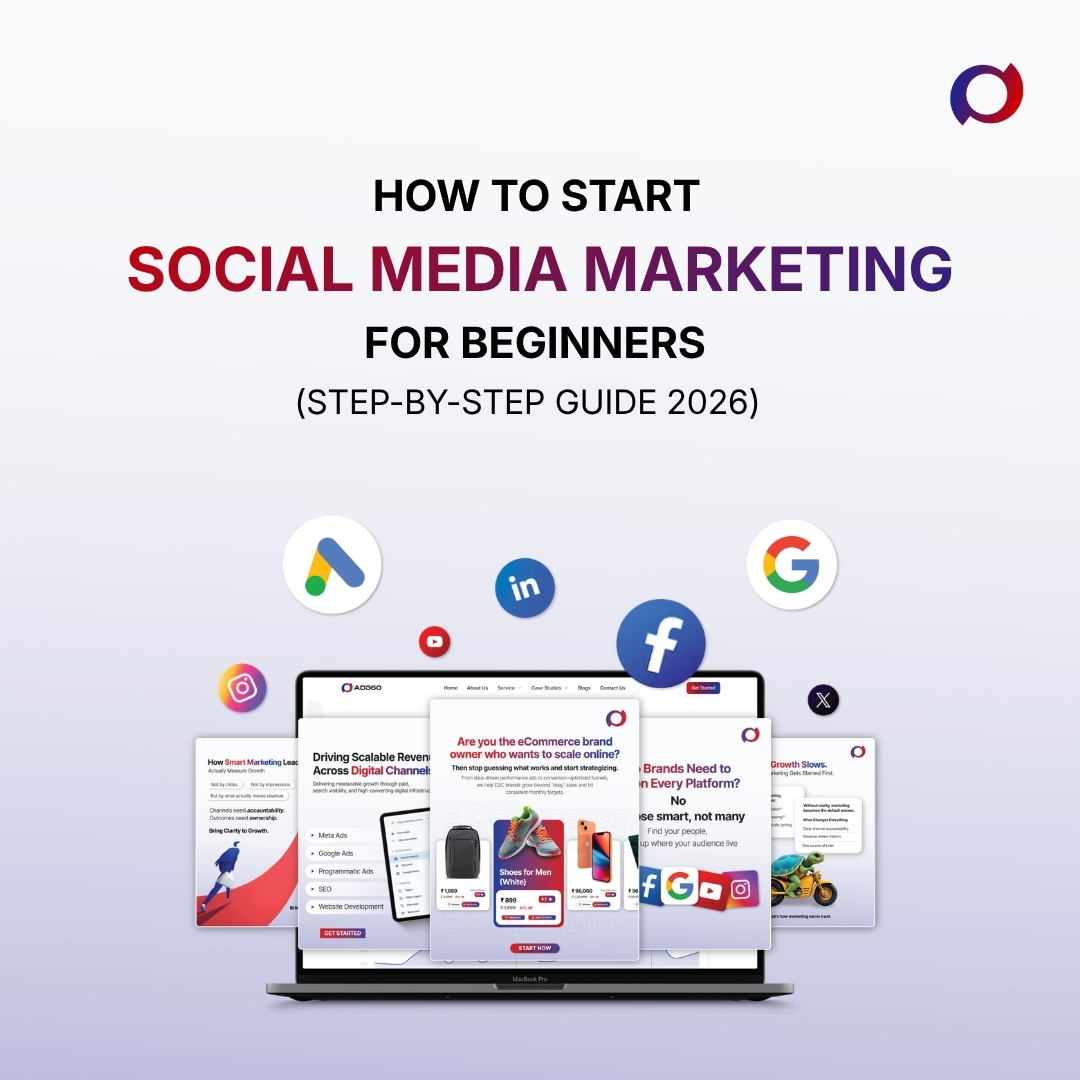
How to Start Social Media Marketing for Beginners (Step-by-Step Guide 2026)
Posted in April 23, 2026
Share On




Table of Contents
ToggleIntroduction
Why Social Media Marketing Is Essential in 2026
Social media is no longer a side channel. It’s where people discover products, evaluate brands, and make buying decisions. A few numbers to put it in perspective:There are 5.66 billion social media users worldwide — roughly 68% of the global population.The global social media market has grown to $234.34 billion in 2026, up from $208.08 billion in 2025.You do not need years of experience or a big budget to get started. This guide walks you through every step in plain, beginner-friendly language.Key Benefits for Businesses, Startups, and Personal Brands
Brand awareness without a big budget. 78% of local businesses rely on social media to build visibility — most started with zero ad spend. A well-crafted Reel or timely post can reach thousands who’ve never heard of you.Direct line to customers. Comments, DMs, and polls reveal what your audience wants in real time. That kind of insight used to cost companies a fortune in research.Lead generation on autopilot. Features like Instagram lead forms and LinkedIn Lead Gen Forms collect enquiries without sending people off-platform. More than 200 million businesses use Instagram monthly to generate this kind of demand.Faster sales cycles. When someone has followed your content for weeks before reaching out, the trust is already built. Social selling accounted for 17% of all online sales in 2025, and that share is climbing.Measurable ROI. Unlike traditional marketing, social gives you reach, click-through rates, cost per lead, and conversions — so you know exactly what’s working.Who Is This Guide For?
If you’ve just graduated, switched careers, or simply want to understand how social media marketing actually works — this guide is written for you. Specifically, it’s for:- Recent college graduates with zero prior digital marketing experience who want to build a career-ready skill.
- Aspiring freelancers and side-hustlers who want to offer SMM services or grow their personal brand from scratch.
- Small business owners and startups who need to handle their own social presence before hiring a team.
- Career switchers who are curious about digital marketing and want a clear, no-jargon starting point.
Understanding Social Media Marketing
Definition and Scope
Social media marketing means using social platforms to promote your brand, products, or services. It covers writing captions, designing graphics, running ad campaigns, and engaging in comments and DMs. The scope is wide: brand awareness, lead generation, customer support, community building, website traffic, or direct in-app sales.Organic vs Paid: What’s the Difference?
Organic social is content you post without paying to promote it — posts, Reels, Stories, replies. It’s free (costs time, not money) and builds trust because followers chose to follow you.Paid social is content boosted with a budget. You pay to reach audiences beyond your followers, defined by age, location, interest, or job title. It’s fast and scalable.Think of organic as the foundation and paid as the accelerant. Neither works as well without the other.Key Platforms at a Glance (2026)
Facebook (3.1 billion users): Best for B2C, local businesses, and community building. The most powerful ad targeting engine available.Instagram (2.3 billion users): Best for visual brands, e-commerce, and personal brands. Reels drive strong organic reach; Instagram Shopping turns posts into purchase points.LinkedIn (1 billion+ users): Best for B2B. 80% of all B2B social media leads come from LinkedIn. Unmatched targeting by job title, industry, and company size.TikTok (1.6 billion users): Highest engagement rate of any major platform at 3.70%. Strong organic reach for new accounts. Ideal if your audience skews under 35.YouTube (2.9 billion users): The world’s second largest search engine. Videos rank on Google and generate organic traffic for years after upload.X / Twitter (450M forecast): Best for real-time commentary, news, and thought leadership. Lower beginner priority unless your niche is news, tech, or finance.Setting Clear Goals
Before creating a single post, decide what you want to achieve. Use the SMART framework: goals should be Specific, Measurable, Achievable, Relevant, and Time-bound.- Brand Awareness: Get more people to know your name. Track reach, impressions, and follower growth. Works well when building a presence from scratch.
- Lead Generation: Collect contact details or enquiries via link-in-bio landing pages, LinkedIn lead forms, or gated content offers.
- Customer Engagement: Build an active community. Track likes, comments, shares, saves, and DMs. High engagement means your content resonates.
- Sales Conversions: Drive direct purchases via Instagram Shopping, TikTok Shop, or website traffic. Track revenue, click-through rate, and conversion rate.
Identifying Your Target Audience
Demographics, Interests, and Behaviour
Understanding who you’re trying to reach shapes every content decision. Start with the basics: age, gender, location, income, and occupation. Then layer in psychographics: pain points, values, and content habits. Platform analytics (Facebook Audience Insights, Instagram Insights, LinkedIn Analytics) give you demographic data about your followers for free.Creating Buyer Personas
Companies using personas acquire 24% more leads than those without, and 56% report higher-quality conversions. A good persona includes name, job role, daily habits, pain points, goals, and preferred platforms.Build one by interviewing customers, reviewing DM comments, or using survey tools like Google Forms or Typeform.Audience Research Tools
- Google Analytics 4 — website audience demographics and behaviour.
- Meta Audience Insights — Facebook and Instagram audience data.
- SparkToro — discover what your audience reads, watches, and follows.
- Brandwatch — AI-powered social listening and sentiment analysis.
- Native platform analytics — free, real-time follower insights on each channel.
Choosing the Right Platforms
B2B vs B2C
For B2B: LinkedIn is the frontrunner. 65% of B2B marketers say it delivers the highest ROI of any social platform. Facebook and YouTube are strong secondary channels.For B2C: Instagram, TikTok, and Facebook are the strongest performers. Social commerce accounted for 17% of all online sales in 2025.Niche Platforms Worth Knowing
Pinterest grew to 500 million monthly active users, with 80% of weekly users discovering a new brand. Strong for food, home décor, fashion, and lifestyle.Reddit, with 49 million global users, works well for community-driven niches and honest product discussions.How to Prioritise Based on Goals
B2B SaaS company? Start with LinkedIn. Fashion brand targeting Gen Z? TikTok and Instagram first.Local restaurant? Facebook and Instagram together give you the broadest local reach.Commit to one or two platforms, master them, then expand — this applies to anyone learning how to start social media marketing for beginners.Building a Content Strategy
Types of Content
- Static posts and carousels — great for educating and informing.
- Short-form video (Reels, TikToks, Shorts) — highest organic reach. 92% of marketers plan to spend the same or more on video in 2026.
- Stories — ideal for real-time updates, behind-the-scenes content, and polls.
- YouTube long-form — builds deep trust and works brilliantly for tutorials and product walkthroughs.
Content Calendar Planning
Scheduling tools like Buffer, Hootsuite, and Later let you plan and auto-publish across multiple platforms from one dashboard.Even a simple spreadsheet covering two to four weeks at a time is enough to start.The 80/20 Rule
80% of your content should provide value — tips, insights, education, entertainment.20% should promote your products or services. Over-promotion pushes audiences away. Value first.Storytelling
Data informs, but stories connect. Share the story behind your brand, your customers’ wins, or the people inside your team.Storytelling-led content consistently outperforms purely informational posts in reach and engagement because it triggers an emotional response.Branding & Consistency
Tone of Voice and Visual Identity
Your tone of voice is how you sound across every post — professional, conversational, or witty. Define it early and document it.Your visual identity covers your colour palette, fonts, logo placement, and overall aesthetic. Both should feel instantly recognisable even before someone sees your handle.Why Consistency Matters
68% of consumers say inauthentic content caused them to unfollow a brand. Posting sporadically or shifting your voice without reason erodes credibility fast.Use a brand kit, maintain consistent profile bios and imagery, and stick to a posting schedule your audience can rely on.Brands like Nike on Instagram show how a clear visual identity and consistent storytelling can build a following of hundreds of millions.Tools & Resources
Scheduling Tools
- Buffer: Clean, beginner-friendly interface. Supports Facebook, Instagram, LinkedIn, TikTok, Pinterest, and X.
- Hootsuite: Comprehensive platform with advanced scheduling, inbox management, and analytics across multiple profiles.
- Later: Particularly strong for Instagram planning, with a visual calendar and link-in-bio page builder.
Analytics Tools
- Google Analytics 4: Tracks traffic from social media to your website, including conversions and on-site behaviour.
- Native platform insights — every major platform provides free analytics. Track reach, impressions, engagement, and follower growth.
- Sprout Social: Advanced cross-platform analytics with competitor benchmarking and customisable reporting.
Design Tools
- Canva: Most accessible design tool for non-designers. Includes templates for every social format and brand kit storage.
- Adobe Express: Adobe’s simplified app for quick social graphics, short videos, and branded templates.
Paid Advertising Basics
Introduction to Facebook, Instagram, and LinkedIn Ads
Global social media ad spend is projected to reach $317.33 billion in 2026. It’s where social media marketing starts to scale.Facebook Ads (also covering Instagram via Meta Ads Manager) offer the broadest targeting options. 86% of marketers worldwide use Meta ads. Even Rs. 500–Rs. 1,000 per day can deliver results with tight targeting.LinkedIn Ads are more expensive but deliver 277% more effective lead generation than Facebook and X for B2B. Start with Sponsored Content and Lead Gen Forms.Budgeting and Targeting Tips
Start with one objective (website traffic or leads), one audience, and one creative. Test for 7–14 days before scaling.Begin with a narrow, specific audience. Custom audiences from your customer list or website visitors consistently outperform broad targeting for beginners.Measuring Ad ROI
Track Cost Per Click (CPC), Cost Per Lead (CPL), and Return on Ad Spend (ROAS).82% of marketers say video marketing has given them a good ROI. If static images are underperforming, test a video creative.Connect your Meta Pixel or LinkedIn Insight Tag to your website to track what happens after the click.Measuring Success
Key Metrics to Track
- Reach: Unique people who saw your content. Measures how widely your message is spreading.
- Impressions: Total times your content was displayed, including multiple views by the same person.
- Engagement rate: Percentage who interacted with your content. The average sits between 1.4% and 2.8% depending on platform.
- Conversions: Actions taken after seeing your content — clicks, sign-ups, purchases. Most directly tied to business outcomes.
How to Track and Adjust
Use each platform’s native analytics as your first dashboard. Export weekly or monthly reports and compare against the previous period.For paid campaigns, use Meta Ads Manager or LinkedIn Campaign Manager. For website traffic, use Google Analytics 4 with UTM parameters on every link.36% of marketers measure success through engagement metrics like likes, comments, and shares. Review data weekly — patterns are more reliable than gut instinct.If a paid ad has a high CTR but low conversion, the issue is likely on your landing page, not the ad itself.Common Mistakes to Avoid
- Posting without a strategy. Posting randomly “just to stay active” wastes time. Every post should have a clear goal, a defined audience, and an intentional call to action.
- Ignoring analytics. Guessing what works is an expensive habit. Make reviewing your data a weekly routine — even when just starting out.
- Being inconsistent. Posting five times one week and going quiet for three weeks breaks algorithmic momentum and erodes audience trust. Three to five times per week, sustained, beats sporadic bursts.
- Over-promoting without adding value. If every post is “buy now,” followers drop and engagement falls. Rotate across educate, inspire, entertain, and promote.
Future Trends in Social Media Marketing (2026)
AI-Driven Personalisation
86% of ad buyers now use generative AI, with AI content projected to form 40% of video ads by 2026.Tools like ChatGPT, Canva Magic Write, and Meta’s native AI features help beginners generate ideas, write copy, and personalise messaging faster and cheaper.Short-Form Video Dominance
TikTok’s engagement rate of 3.70% remains the highest of all platforms, and YouTube Shorts is growing rapidly alongside it.41% of B2B marketers say short-form video drives the highest ROI of any video format. A smartphone and good lighting are genuinely enough to start.Social Commerce
The global social commerce market is projected to reach $2.11 trillion in 2026. Instagram Shopping, TikTok Shop, Facebook Shops, and Pinterest product pins let customers buy without leaving the app.For businesses selling physical products, setting up a native social shop is now essential, not optional.Micro-Influencer Partnerships
83% of marketing professionals say micro-influencers drive better commercial results than traditional celebrities, with engagement rates between 7% and 20%.In 2026, brands are forming longer-term creator partnerships where creators become co-creators and community builders, not just paid promoters.FAQs
How Much Budget Do I Need to Start?
You can start social media marketing for beginners with zero budget using organic content alone. For paid ads, Meta platforms let you run test campaigns from as little as Rs. 300–Rs. 500 per day. The most important early investment is time.
Which Platform Is Best for Beginners?
Instagram is usually the best starting point for consumer-facing brands. For B2B, start with LinkedIn. Pick one, master it for 60–90 days, then expand.
How Long Before I See Results?
Organic social media marketing takes 3–6 months. Paid ads can generate leads within days, but require 2–4 weeks of testing.

Leave a Reply