
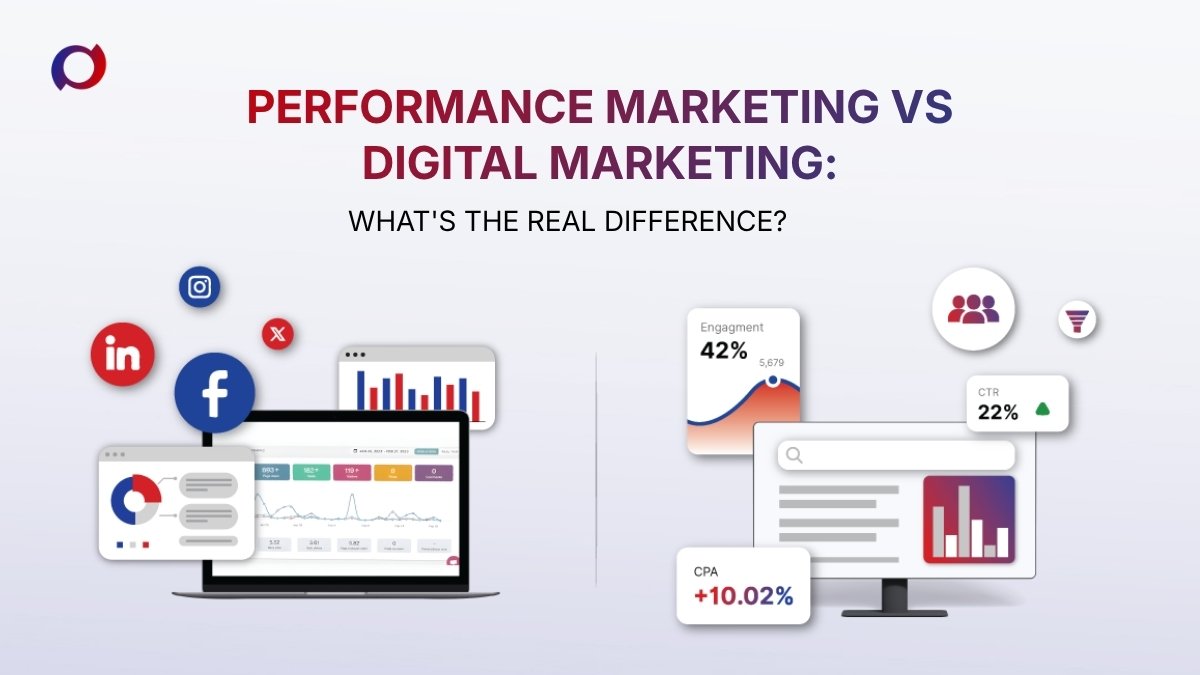
Performance Marketing vs Digital Marketing: What’s the Real Difference?
Posted in October 5, 2026
Share On




A founder we spoke with last year had a simple complaint. She had hired a digital marketing agency, but every review call turned into a debate about whether the team should be chasing sales or chasing visibility. Her agency kept mixing the two goals into one report, and neither she nor her team could tell if the work was actually paying off.That mix-up is common. Digital marketing is the umbrella term for every online activity a brand runs, from SEO to email to paid ads. Performance marketing sits inside that umbrella as one specific, results-obsessed approach.The confusion around performance marketing vs digital marketing usually comes down to scope. One is broad and long-term, the other is narrow and tied to numbers you can point to on a dashboard.This guide walks through what each term actually means, how they differ in objectives, measurement, and channels, and how most successful brands end up using both together rather than picking a side.
Table of Contents
ToggleWhat Is Digital Marketing?
Definition of Digital Marketing
Digital marketing is the broad practice of promoting a brand, product, or service through any online channel. It covers everything a business does on the internet to reach and engage an audience.This includes both paid activity, such as running ads, and organic activity, such as publishing content or growing a social following without paying for reach.Key Types of Digital Marketing
Most digital marketing strategies draw from a mix of these disciplines, often running several at once.- SEO: improving a website’s visibility in organic search results
- Content marketing: blogs, guides, and videos that attract and educate an audience
- Social media marketing: building a presence and community on platforms like Instagram or LinkedIn
- Email marketing: nurturing leads and customers directly in their inbox
- PPC or paid advertising: buying visibility through ad auctions on Google, Meta, and other platforms
- Influencer marketing: partnering with creators to reach their audience
- Affiliate marketing: paying partners a commission for sales or leads they refer
- Online PR: earning coverage and mentions on other websites and publications
What Is the Main Goal of Digital Marketing?
Digital marketing is judged against a wide set of goals, not a single number. A campaign can be considered successful even if it never directly closes a sale.- Brand awareness
- Visibility in search and social feeds
- Engagement with content and community
- Traffic to the website
- Lead generation
- Customer retention
- Sales, as one goal among several
What Is Performance Marketing?
Definition of Performance Marketing
Performance marketing is a results-driven approach where advertisers pay marketing partners only when a specific, measurable action is completed, rather than paying for impressions or reach alone.Those measurable actions include clicks, leads, purchases, app installs, or registrations. If the action cannot be tracked, it usually does not count as performance marketing.How Performance Marketing Works
Every performance marketing campaign follows roughly the same loop, regardless of the platform or industry involved.- Campaign: define the offer and the specific action you want a user to take
- Target Audience: identify who is most likely to complete that action
- Ad or Offer: put the message in front of that audience
- User Action: the click, sign-up, or purchase that gets tracked
- Tracking: capture that action back to the exact campaign and ad
- Optimization: adjust targeting, budget, or creative based on what the data shows
- Better Results: repeat the loop with sharper targeting and lower cost per outcome
Common Performance Marketing Channels
| Channel | Typical use |
|---|---|
| Google Ads | Capturing intent from people already searching for a solution |
| Meta Ads | Reaching and converting audiences on Facebook and Instagram |
| LinkedIn Ads | B2B lead generation and account-based targeting |
| Affiliate marketing | Paying partners a commission per sale or lead they generate |
| Display advertising | Programmatic banner ads targeted by audience and intent |
| Retargeting | Re-engaging visitors who did not convert on their first visit |
| Shopping or product ads | Showing product listings directly in search results |
| Programmatic ads | Automating ad buying to reach the right audience across websites and apps |
Performance Marketing vs Digital Marketing: What’s the Difference?
Laid side by side, the difference between performance marketing and digital marketing becomes much clearer than it sounds in theory.| Factor | Digital Marketing | Performance Marketing |
|---|---|---|
| Scope | Broad | More specific |
| Primary focus | Overall online growth | Measurable results |
| Main objective | Awareness, engagement, traffic, leads and sales | Leads, sales, conversions, revenue |
| Measurement | Multiple brand and marketing metrics | Highly focused on performance metrics |
| Payment model | Various, including flat fees and retainers | Often tied closely to measurable outcomes |
| Time horizon | Short and long term | Often focused on immediate, measurable outcomes |
| Optimization | Campaign, content, and brand optimization | Continuous performance and conversion optimization |
| Examples | SEO, content, social media, email | PPC, affiliate, paid social, retargeting |
Is Performance Marketing Part of Digital Marketing?
Yes. Performance marketing is not a separate category sitting next to digital marketing. It is a results-focused approach that lives inside the broader digital marketing ecosystem.Think of digital marketing as the entire toolbox and performance marketing as the specific tools you reach for when you need a measurable, near-term outcome.A simple example: a skincare brand runs SEO and Instagram content to build awareness over months. At the same time, it runs Google Shopping ads to drive same-week sales. The first is digital marketing at large. The second is performance marketing operating within it.Key Metrics: Digital Marketing vs Performance Marketing
Digital Marketing Metrics
These metrics track overall health and reach rather than a single transaction. Organic search alone has historically been estimated to drive roughly half of all website traffic, and around 64% of traffic for B2B companies, which is why digital marketing teams watch it closely even without a direct sale attached.- Organic traffic
- Website engagement
- Social reach
- Brand mentions
- Email engagement
- Search visibility
Performance Marketing Metrics
Performance metrics are tied to cost and outcome, which is why campaigns get judged weekly or even daily. For context, the average click-through rate across Google Search ads sits around 3.17%, giving teams a benchmark to optimise against.- CTR (click-through rate)
- CPC (cost per click)
- CPL (cost per lead)
- CPA (cost per acquisition)
- ROAS (return on ad spend)
- Conversion rate
- Customer acquisition cost
- Revenue generated
When Should You Choose Digital Marketing?
Digital marketing is the better fit when a business is playing a longer game and cannot judge success by a single week’s sales numbers.- Long-term brand building that compounds over months and years
- Organic visibility that reduces dependence on paid traffic over time
- Thought leadership that builds trust with a niche audience
- Customer engagement through content and community
- Brand awareness in a new or competitive market
- Sustainable traffic growth that does not disappear the moment ad spend stops
When Should You Choose Performance Marketing?
Performance marketing earns its budget when a business needs a result now, and needs to know exactly what it cost to get there.- Immediate lead generation for a sales team that needs a full pipeline
- Ecommerce sales that need to hit a revenue number this month
- Measurable customer acquisition with a clear cost ceiling
- Campaign-specific results, such as a product launch or seasonal sale
- Scalable paid acquisition once a winning offer has been found
- Clear ROI tracking for finance or leadership reporting
Can You Use Digital Marketing and Performance Marketing Together?
Yes, and most brands that grow steadily end up doing exactly this. The two approaches are not competing budgets, they are complementary layers of the same strategy.- SEO plus paid search, so you capture both free and paid clicks on the same keywords
- Content plus paid social, using organic content as ad creative once it proves itself
- Organic social plus retargeting, turning followers into a warm retargeting audience
- Brand awareness campaigns plus conversion campaigns running in parallel
- Email nurturing plus paid acquisition, so new leads are not left to go cold
Example of an Integrated Strategy
A common funnel looks like this: SEO brings in a visitor, content earns their trust, a paid ad re-engages them with an offer, a landing page converts them, and retargeting brings them back for a repeat purchase.This kind of layered approach is one reason global digital ad spend has kept climbing toward roughly $740 billion in 2026, with total advertising spend worldwide expected to cross $1 trillion for the first time this year.Performance Marketing vs Digital Marketing: Which One Is Better?
Neither approach is universally better. The right mix depends on where a business stands and what it needs right now.- Business goals: brand building versus immediate revenue
- Budget: what can be committed monthly versus what needs to show fast return
- Industry: some categories rely more on trust and content, others convert on price and speed
- Customer journey: how many touchpoints a buyer typically needs before purchasing
- Sales cycle: short impulse purchases versus long B2B decisions
- Desired timeframe: results this quarter versus growth over several years
- Growth stage: a new brand often needs more awareness work, an established one needs more conversion work
FAQs About Performance Marketing vs Digital Marketing
Is performance marketing the same as digital marketing?
No. Performance marketing is one specific, results-focused approach within the much broader field of digital marketing.
Is SEO performance marketing or digital marketing?
SEO is generally classified as digital marketing. It builds long-term organic visibility and is harder to tie directly to a single measurable action or a fixed cost per result.
Is Google Ads performance marketing?
Yes. Google Ads is one of the most common performance marketing channels because spend is tied directly to clicks, leads, or purchases that can be tracked and optimised.
What is the difference between performance marketing and online marketing?
Online marketing is essentially another term for digital marketing, covering all online promotional activity. Performance marketing is the subset of that activity focused strictly on measurable, trackable outcomes.
Which is better for generating leads: digital marketing or performance marketing?
Performance marketing usually generates leads faster since it is built around tracked actions. But digital marketing tactics like content can be highly efficient too, generating roughly three times more leads at 62% lower cost than traditional marketing over time.
Can performance marketing work without digital marketing?
Not really. Performance marketing runs on digital infrastructure such as websites, landing pages, and tracking pixels, all of which fall under the digital marketing umbrella. It cannot function in isolation from it.


Leave a Reply